
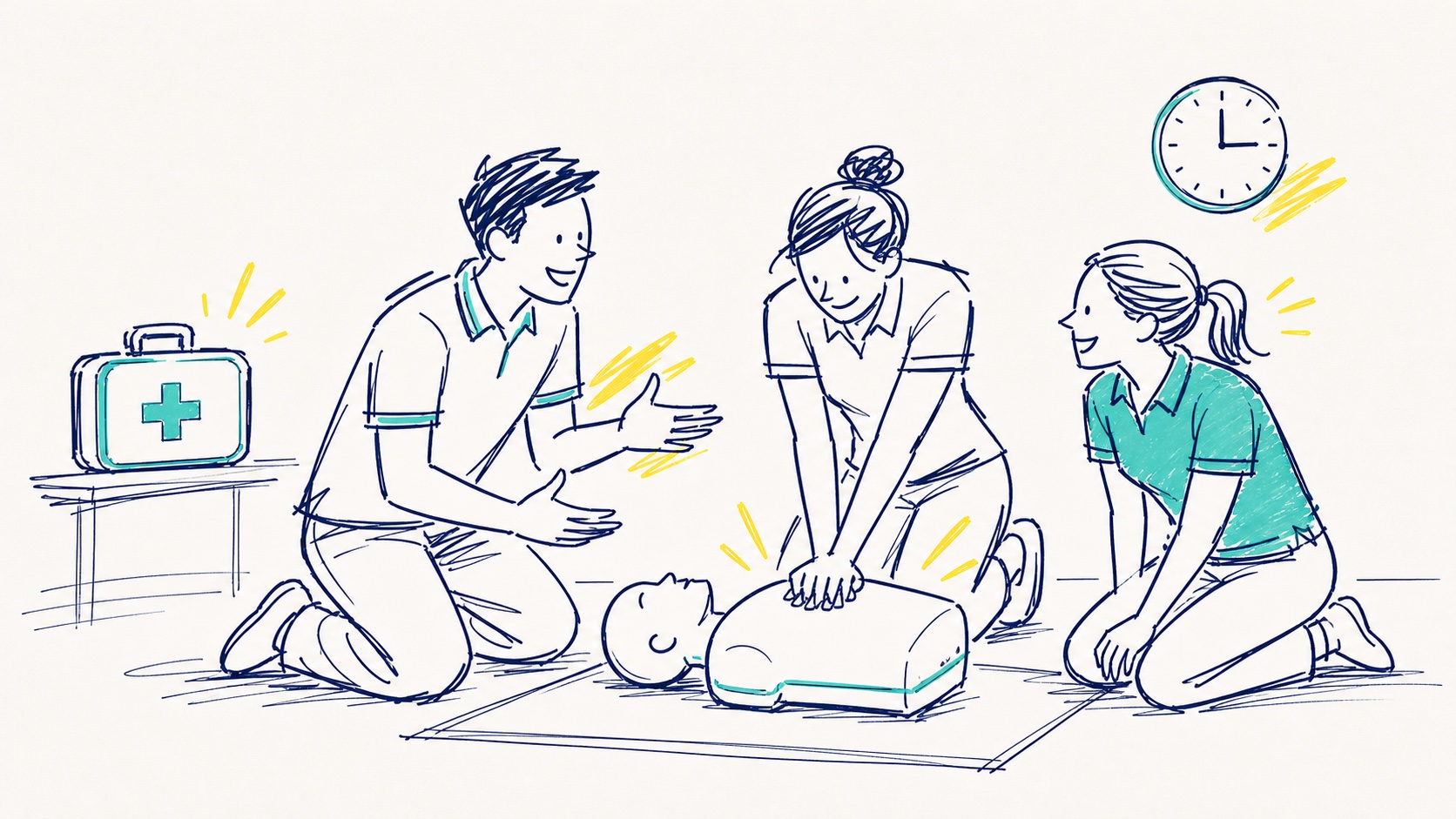
If you’ve searched “express first aid training Brisbane”, you’ve probably had the same question as everyone else: “Is this actually legit, or is it just a rushed version of the real thing?”
Fair question. First aid is not the place for shortcuts. Nobody wants a certificate that looks fine in a folder but leaves staff quietly hoping an emergency never happens.
Express first aid training can be nationally recognised and genuinely useful. You just need to know what has been shortened, what has not, and whether the provider is still assessing people properly. This guide walks through the difference so you can save time without ending up with a flimsy tick-and-flick course.
What Does Express First Aid Training Brisbane Usually Mean?
Express first aid training is a faster delivery format for nationally recognised first aid units such as HLTAID011 Provide First Aid and HLTAID009 Provide cardiopulmonary resuscitation. The certificate should be the same unit of competency you would receive from a traditional provider. The session itself is what changes.
That is the important bit: express should mean efficient, not incomplete.
In the Brisbane market, many express first aid courses use a blended model: you complete online theory first, then attend a short practical or assessment session. That can work well for confident refreshers, but it is not the only way to save time.
At Team First Aid, we call it X-press training because, yes, it is an express course, but it needs the X factor too: hands-on delivery, a trainer who can read the room, and staff walking out more confident than when they came in. The aim is not to race through the important stuff or dump half the learning onto your staff at home. It is about cutting the dead time: long breaks, duplicated explanations, irrelevant war stories, slow admin, venue travel, and the kind of PowerPoint slide that makes adults reconsider every life decision that brought them into that room.
Nationally recognised still means nationally recognised
HLTAID011 must cover the skills and knowledge required to provide first aid in line with Australian Resuscitation Council guidelines and other national clinical guidance. A shorter format still needs proper training, practical assessment and evidence of competency.
For a Brisbane business, express training usually matters because you are trying to train a group without losing the whole team for a full day. If you have 10, 15 or 30 staff, a focused onsite session can save a serious chunk of the work week.
Picture Megan, the practice manager at a northside clinic. She has 14 staff due for renewal, two receptionists on rotating days, and a treatment room that cannot be left uncovered for a full day. A public course might technically be cheaper per head, but by the time she splits the team across dates, checks online theory completion, handles travel questions and fills roster gaps, the admin has become the job. Express onsite training avoids a lot of that mess.
Can Express First Aid Training Brisbane Get You Certified in Half the Time?
Yes, if the provider is delivering the same required competency and assessing it properly. No, if “half the time” means skipping the hands-on work, rushing assessment, or waving people through because they attended.
The official HLTAID011 unit describes first aid response skills for community and workplace settings, including recognising emergencies, applying first aid procedures, communicating incident details and reviewing the incident. The HLTAID009 CPR unit also requires performance in line with ARC guidelines, including practical CPR and AED use.
Those outcomes do not disappear because the course is faster.
What can change is how efficiently the session is run. A sharp trainer can keep the group moving, focus on what adults actually need, use realistic workplace scenarios, and avoid dragging a 4-hour learning experience into an 8-hour endurance test.
8hrs
Typical full-day first aid course commitment before travel
~4hrs
Typical X-press onsite session window for many workplace groups
0hrs
Staff travel time when training happens at your workplace
50%
Approximate reduction in training downtime for many Brisbane teams

The certificate is not “express”. The wasted time is.
What Can Be Shortened Without Lowering Quality?
A good express first aid course trims the fat, not the muscle.

1. Travel and venue downtime
If your staff drive across Brisbane to a public course, they lose time before the training even starts. Add traffic, parking, check-in, finding the room, waiting for late arrivals and getting back to work afterwards. None of that improves someone’s CPR technique.
Onsite first aid training removes that chunk entirely. The trainer comes to your workplace with the mannequins, AED trainers, bandages and course materials. Your team walks into a meeting room, trains, and gets on with the day.
2. Generic examples
Traditional public courses have to work for everyone in the room: office staff, tradies, childcare educators, warehouse teams, hospitality workers and the one person who has somehow done six first aid courses but still asks whether you can shock someone twice with an AED.
Onsite express training can be tighter because the examples match your actual workplace. A childcare centre spends more time on infant and child scenarios. An electrical business pays closer attention to electrical incidents and CPR readiness. An office team can map response steps around its own first aid kit, AED location and floor plan.
3. Repetition that does not help learning
Adults do not need every concept explained three different ways if they understood it the first time. They need clarity, practice, feedback and confidence. A strong trainer can read the room and move at the right pace.
Ask how the time is saved
Before booking any short first aid course in Brisbane, ask the provider what has changed. Good answer: efficient delivery, onsite setup, focused trainer-led practice. Bad answer: vague promises about “streamlined content” with no mention of assessment.
4. Admin friction
For group training, admin can quietly become the real job. Chasing names, checking enrolments, answering venue questions, comparing dates, handling certificates afterwards. A well-run onsite provider should make this simple, especially for office managers and admin teams who have plenty else to do.
What cannot be shortened
This is the important bit. Some parts of first aid training should never be treated as optional.
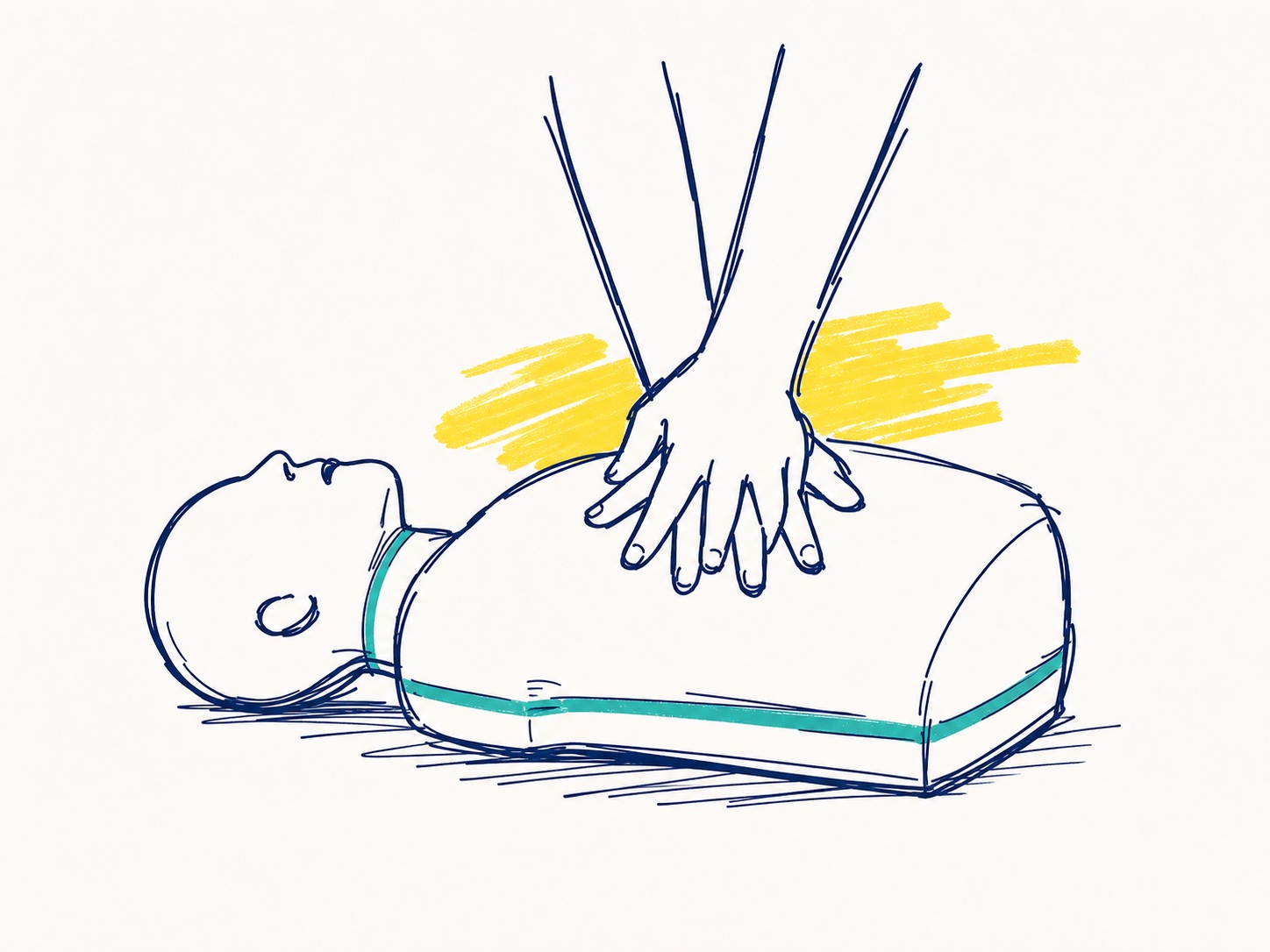
Practical CPR assessment
CPR is physical. You cannot learn it properly by watching a video and nodding along. Participants need to demonstrate CPR on appropriate manikins and be assessed against the unit requirements.
The HLTAID009 assessment requirements include practical evidence such as uninterrupted single-rescuer CPR on an adult manikin placed on the floor, AED prompt-following, and CPR on an infant manikin. So no, there is no credible version of CPR training where everyone just sits there politely.
First aid scenarios
First aid is decision-making under pressure. Your team needs to practise recognising an emergency, keeping themselves safe, calling for help, applying first aid and communicating what happened.
Good express training still includes scenario work. It just keeps those scenarios relevant instead of spending half the session on examples your workplace will never face.
Competency judgement
Nationally recognised training is not attendance-based. A provider must be satisfied the participant is competent. A trainer needs enough time and structure to observe, correct and assess.
Short is not the same as automatic
If a course implies everyone passes just by turning up, be careful. A nationally recognised statement of attainment should reflect competency, not seat-warming.
Express vs traditional first aid training
Side by side, the trade-off is pretty clear.
X-press onsite training
Efficient session at your workplace
- Roughly half the time of traditional courses
- Same nationally recognised units
- No staff travel across Brisbane
- Workplace-specific examples and hazards
- One booking for the whole team
- Usually needs a group of 6+
Traditional public course
Staff attend a scheduled venue course
- Often a full-day commitment
- Same nationally recognised units when RTO-backed
- Travel, parking and venue admin
- Generic examples for mixed groups
- Multiple dates if several staff need training
- Useful for individuals and tiny teams
For one person, a public course may be perfectly sensible. For a team, especially a Brisbane workplace with six or more staff, onsite express training usually wins because it removes the waste around the training.
Why Brisbane Workplaces Care About Faster Training
First aid training is important, but it is rarely the only thing happening that week. Clinics have patients. Schools have classes. Warehouses have orders. Offices have deadlines. Losing half the team to a full-day course can create a ripple effect that lasts longer than the course itself.
Safe Work Australia says workplaces must provide access to first aid equipment, facilities and trained first aiders, and first aid needs should be based on workplace hazards, size and location. So the training has to happen. The aim is to organise it without making a mess of the week.
Brisbane / Queensland
Time savings matter more when traffic joins the course
A “full-day course” can easily become nine or ten hours once staff travel from North Brisbane, the bayside, Ipswich, Logan or the west. Onsite training removes the commute from the equation completely.
For a team of 15, even a conservative 4-hour saving per person gives you 60 staff hours back. At $40 per hour fully loaded, that is $2,400 of productive time saved before you even count petrol, parking or the admin work of coordinating multiple dates.
That is why “fast first aid training Brisbane” is often less about impatience and more about rosters, patients, shifts, jobs and opening hours.
Want to see what X-press training would cost for your team?
How to Tell If an Express First Aid Course in Brisbane Is Legit
Use this quick checklist before booking.

1. Check the unit codes
For general workplace first aid, you are usually looking for HLTAID011 Provide First Aid, which includes CPR. For annual refreshers, you may only need HLTAID009 CPR. Childcare and education settings often need HLTAID012.
The provider should clearly state the unit codes, not just say “first aid certificate”.
2. Confirm who the RTO is
Nationally recognised training must be delivered under a Registered Training Organisation arrangement. Team First Aid delivers on behalf of ABC First Aid, RTO 3399.
3. Ask about practical assessment
Any credible provider should be comfortable explaining what participants need to demonstrate. For CPR, that means real practice on manikins, AED use and trainer observation, with training consistent with ANZCOR/ARC resuscitation guidance.
4. Look for confidence, not just speed
Fast is only useful if people leave knowing what to do. Look for signs the course is hands-on, engaging and scenario-based. Reviews are helpful here because past students will tell you whether the session felt useful or like a box-ticking exercise.
Sarah Wilson’s feedback is a good example. After her team’s X-press session, the thing that stood out was not just that it was shorter. Her staff felt more confident because the training stayed focused on what they could actually absorb and use.
The X-press sessions were a definite winner. Our staff came away feeling that they were able to absorb what they had learnt, rather than feeling overwhelmed by hours of information.
That is the point. Less can be better, but only when the session is hands-on first. Shorter should feel sharper, not thinner.
5. Make sure the format suits your team
Express onsite training is brilliant for groups. It is less ideal if you have one person who needs a certificate tomorrow, or if your team genuinely cannot be in the same place at the same time.
Who Should Choose Express First Aid Training?
Best fit
Choose X-press onsite if…
- You have 6+ staff needing first aid or CPR
- You want less downtime across the team
- You prefer one date and one organiser
- Your workplace has specific hazards
- You want staff to actually enjoy the session
Usually fine
Choose public training if…
- You only need to train one or two people
- A new hire needs certification urgently
- Your team cannot align on one session time
- You are happy for staff to travel to a venue
Check first
Pause if…
- The provider will not name the unit codes
- Assessment sounds vague or optional
- The course promises a certificate with no hands-on work
- The time saving is never explained
If you are organising training for a Brisbane workplace, the decision usually comes down to group size and disruption. If six or more people need certification, onsite X-press training is normally the cleaner path.
Common Myths About Short First Aid Courses
Myth 1: “Shorter means less recognised”
Not necessarily. Recognition depends on the unit, RTO arrangement and assessment quality, not whether the session felt painfully long.
Myth 2: “A full-day course must be better”
Sometimes longer just means longer. A full-day course can be excellent, but time alone does not guarantee better learning. A focused, well-run session can outperform a slow one because people stay engaged.
Myth 3: “The shorter the course, the better”
Not quite. There is a point where “efficient” can tip into “ship them in, ship them out”.
If a full first aid unit is squeezed into two hours or less, ask what the trade-off is. Are staff getting time to ask questions? Time to practise until they feel confident? Time to breathe, interact and make mistakes before the real thing?
A certificate is useful. Skills are better. The goal is not to get people through the door as fast as possible; it is to help them feel ready to save the life of a coworker, customer or loved one if they ever have to.
There is an organisational risk here too. If something goes wrong and the incident is reviewed, a certificate may not be the only thing people look at. They may ask whether staff were genuinely trained, or whether they were rushed through such a short session that they were left guessing in the moment. That is not a place any workplace wants to be.
Myth 4: “Express training is only for office workers”
Nope. The format can work well for schools, childcare centres, clinics, warehouses, trades and community organisations. The content needs to match the workplace risk, but efficiency helps almost every team.
Myth 5: “Online-only first aid is enough”
For nationally recognised first aid and CPR, practical assessment matters. Online learning can support a course, but your team still needs to demonstrate hands-on skills where the unit requires it.
Do not gamble on paper confidence
The point of workplace first aid training is not a certificate in a drawer. It is having trained people who can respond when someone collapses, bleeds, burns, chokes or stops breathing. If an incident is later reviewed, “they had a certificate” may not feel very reassuring if the team were never confident with the skills.
The Bottom Line on Express First Aid Training in Brisbane
Express first aid training can work without lowering the standard, as long as the provider keeps the required training and assessment intact.
For Brisbane workplaces, the win is simple: your staff get nationally recognised training, practise the skills that matter, and lose far less of the workday to travel, waiting and filler. That is what X-press training is built for.
If you are comparing express first aid training Brisbane options, ask providers how they save time, what unit codes they deliver, who the RTO is, and how participants are assessed. The answers will tell you quickly whether you are looking at a smart format or a shortcut dressed up as convenience.
Frequently asked questions
Is express first aid training nationally recognised?
It can be, yes. The key is that the course must deliver the relevant nationally recognised unit, such as HLTAID011 Provide First Aid or HLTAID009 CPR, through a proper RTO arrangement with required assessment completed.
Can first aid training really be done in half the time?
Yes, when the provider saves time through efficient delivery, onsite training, focused scenarios and strong facilitation. The required practical assessment still needs to happen. The saving should come from removing wasted time, not removing competency.
What is the difference between express first aid and a normal first aid course?
A normal public course often runs for a full day at a training venue. Express onsite training is designed to cover the same required outcomes more efficiently at your workplace, with less travel, less generic content and more relevant workplace examples.
Who is express first aid training best for?
It is best for workplaces with six or more staff who need first aid or CPR training. It is especially useful for Brisbane teams that want one booking, less downtime and training examples matched to their actual workplace.
Does CPR still need hands-on assessment in an express course?
Yes. CPR is a practical skill. Participants need to demonstrate the required skills, including CPR on manikins and AED use, where required by the unit. A faster course should still include proper trainer observation and feedback.
Is the shortest first aid course always the best option?
No. Shorter is only better when the course still gives people time to practise, ask questions and build confidence. If a course is so compressed that staff are rushed through the room, they may leave with paper but not much practical confidence. If a real incident is later reviewed, that lack of confidence could become part of the conversation.
How do I get a price for X-press first aid training in Brisbane?
You can use Team First Aid’s quote calculator to see your price in about 60 seconds. Add your course, group size and location, and you will get a clear price without waiting for a callback.
Ready when you are
Book X-press first aid training for your Brisbane team
See your price in about 60 seconds. No forms. No phone calls. No one’s going to ring you.
★★★★★
200+ five-star reviews from Brisbane workplaces