
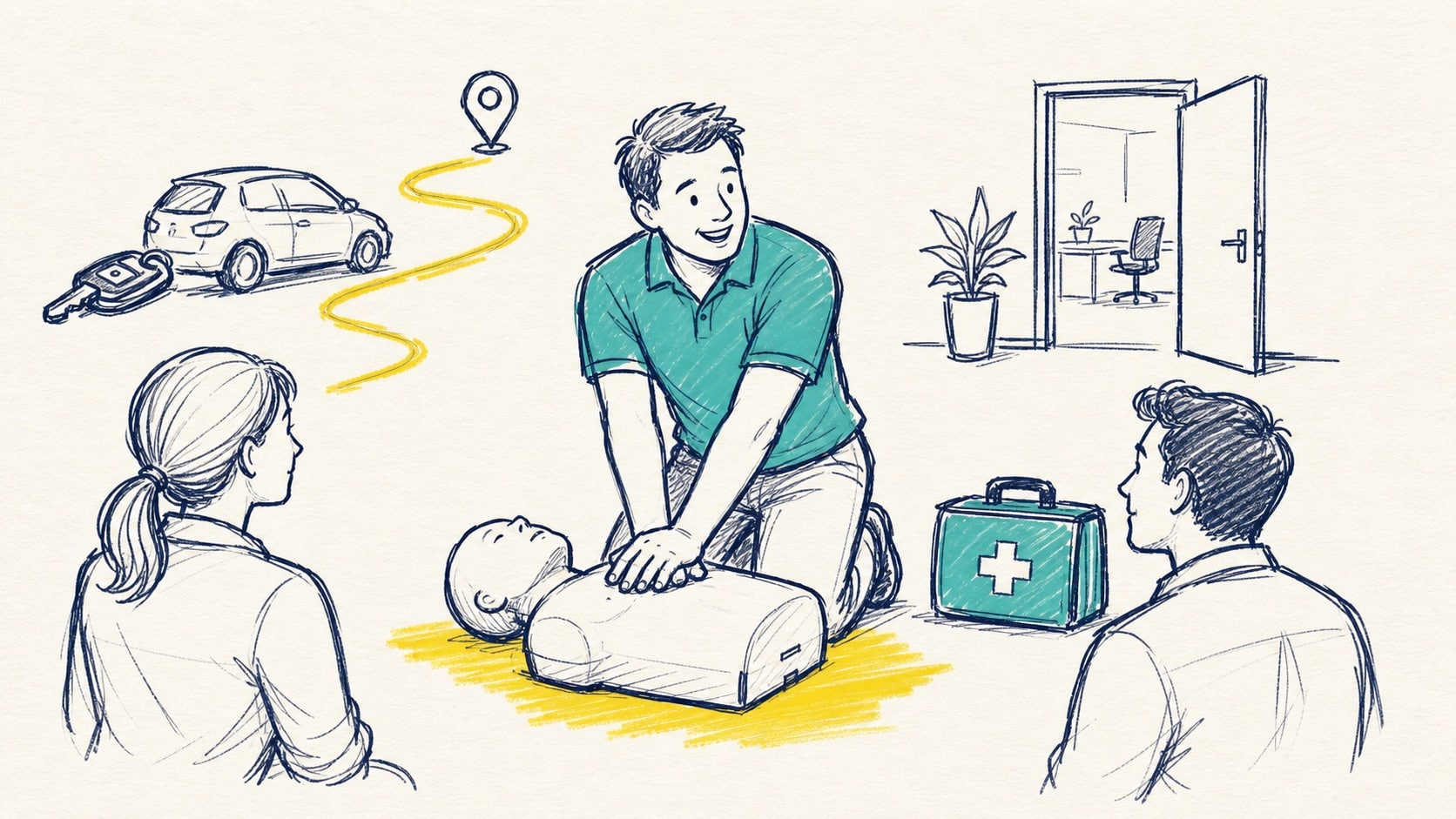
Your team's first aid certificates are about to expire. You've got two paths: send everyone to a training centre across Brisbane, or bring the trainer to your workplace. Both get the job done. But one option wastes a lot less of everyone's time, and the real cost difference might surprise you.
If you're the person who's been asked to "sort out first aid training this year," you already know the headache. Coordinating dates, comparing providers, figuring out what's actually going to work for your team without blowing the budget or losing a full day of productivity.
This guide breaks down onsite vs offsite first aid training for Brisbane workplaces: the real costs, the hidden time savings, and a straightforward decision framework so you can pick the best approach to workplace first aid training for your team.
Onsite vs offsite: the two options
Before we compare, let's make sure we're talking about the same thing.
What is onsite first aid training?
A qualified trainer comes to your workplace with all the equipment: mannequins, bandages, AED trainers, the lot. Your team trains together in your own space. The session is tailored to your environment, and everyone's done in one hit. No travel, no coordination across multiple dates. That's the core of onsite first aid training.
For Brisbane businesses, onsite training typically requires a minimum of six attendees. The trainer covers the same nationally recognised units of competency (HLTAID011 for Provide First Aid, HLTAID009 for CPR) as any public course.
What is offsite (public course) first aid training?
Your staff individually enrol in a scheduled course at a training venue. They drive there, complete the session alongside participants from other businesses, and drive back. Public courses are ideal for individuals or small teams who can't meet onsite minimums.
Brisbane has dozens of public course venues scattered from Murrumba Downs to the south side. Course quality and duration vary wildly between providers.
Onsite vs offsite at a glance
Onsite X-press training
Trainer comes to your workplace
- Roughly half a day (X-press format)
- Zero travel time
- One date — whole team sorted
- Tailored to your workplace hazards
- Renewal dates aligned across the team
- Minimum 6 attendees
Offsite (public course)
Staff travel to a venue
- Full day (7–8 hours) plus travel
- 30–60 min each way in Brisbane traffic
- Multiple dates to coordinate
- Generic scenarios — any industry
- Renewal dates scattered across calendar
- Great for 1–2 people or new hires
Cost comparison: the numbers most people miss
This is where it gets interesting. On paper, the per-person course fee looks similar. But course fees are only part of the equation.
The per-person price
Public first aid courses in Brisbane typically run between $90 and $150 per person for HLTAID011 (Provide First Aid). Onsite group first aid training in Brisbane starts from around $110 per person for standard groups, with volume discounts kicking in at 18+ attendees (10% off) and 30+ attendees (20% off).
At face value, offsite looks a touch cheaper. But that's before you factor in the costs that don't appear on any invoice.
The hidden costs of sending staff offsite
When Lisa at Genesis Physiotherapy needed to recertify her team of 12 last year, she initially booked everyone into public courses across three different dates. After factoring in travel time, parking at the training venue, and the fact that each person was out for a full eight-hour day, she calculated the real cost was nearly double the course fee alone.
Here's how the hidden costs stack up for a typical Brisbane team of 15.
135hrs
Lost to offsite training (team of 15, incl. travel)
60hrs
Same team, X-press onsite — back by lunch
75hrs
Productive hours reclaimed
$3k+
Productivity saved (at $40/hr fully loaded)
Direct cost is almost identical between the two options once you do the maths properly. But your team gets back roughly 75 hours of productive time — and you skip the admin headache of juggling multiple session dates.

For a more detailed breakdown of onsite training pricing in Brisbane, including minimum booking costs and volume discounts, check out our onsite first aid training cost guide for Brisbane.
Curious what onsite would cost for your team?
Get a price in 60 secondsTime: how much does each option really take?
Time is usually the deciding factor when organising first aid training for staff at Brisbane businesses. Nobody wants to lose their team for a full day if they don't have to.
Offsite: a full-day commitment (plus travel)
A standard public Provide First Aid course runs 7 to 8 hours. Add 30 to 60 minutes of travel each way in Brisbane traffic (more if your staff are coming from the north side to a south-side venue, or vice versa), and you're looking at 9 to 10 hours per person.
If you need to send staff across multiple session dates because the venue caps at 15 to 20 people, the disruption compounds. You're running a reduced team for two or three separate days instead of one.
Onsite: half the time, zero travel
X-press onsite sessions, effectively an express first aid course delivered at your workplace, run in roughly half the time of traditional courses. No filler. No recycled war stories. No death by PowerPoint. Your team covers everything they need for nationally recognised certification, and they're back at their desks by lunch.
Mark from a Brisbane electrical firm put it this way after switching from offsite to onsite for his crew of 20: he'd been losing two full days of productivity each year to first aid recertification (splitting the team across two offsite sessions). With onsite X-press training, the whole crew was done in a single morning. That freed up an entire day he hadn't expected to get back.
Legal requirement, not optional
Under Safe Work Australia guidance, every Australian workplace must have trained first aiders proportionate to their risk level. Training isn't optional — the only question is how to minimise the disruption.
For most Brisbane businesses with 10+ staff, onsite training saves 40–60% of the total time investment compared to sending people offsite. Over a three-year certification cycle with annual CPR refreshers, those hours add up fast.
Training quality and engagement
A certificate is a certificate. But there's a big gap between staff who walk out genuinely confident and staff who scraped through a long day they'd rather forget.
Workplace-specific scenarios
Onsite training lets the trainer tailor scenarios to your actual environment. A warehouse crew practises responding to forklift incidents. A childcare centre focuses on infant choking and febrile convulsions. An office team works through cardiac arrest response with their own AED location in mind.
Public courses, by nature, cover generic scenarios. They have to cater to a room full of people from completely different industries. That's not a flaw, it's just the reality of training 15 strangers together.
The team dynamic
There's something about learning alongside your actual colleagues that sticks. When your team practises CPR together, they're not just learning a skill in isolation. They're building the confidence to act when it matters, in their own workplace, with the people they'd actually be helping.
After doing first aid courses every year for over 20 years I would have to say last week was the best First Aid course I have ever attended. Thank you for the short, sharp session that included so many new facts that had not been shared with us before.
That kind of feedback doesn't come from a checkbox exercise.
What staff actually prefer
Nobody's ever excited about mandatory training. But the feedback gap between engaging onsite sessions and traditional full-day courses is stark. Across 200+ five-star Google reviews, the most common themes are "actually enjoyed it," "best first aid course I've done," and trainers praised by name.
The difference between a team that's confident and a team that's just certified matters when someone actually needs help.
Logistics and admin
If you're the person organising training, this section is for you.
The scheduling headache
Offsite training means finding dates that work for your staff, checking venue availability, and hoping the sessions don't fill up before you've sorted your team's rosters. If you've got 20 people and the venue caps at 15, that's two separate dates to manage. If some staff can't make either date, you're into a third.
Onsite simplifies this to a single conversation: "When suits your team?" One date, one session, everyone done.
Amazing! So easy to organise, great with communication.
For a busy admin or office manager, that's the whole pitch right there.
Equipment and space
For onsite, you just need a room big enough for your group. The trainer brings everything: mannequins, bandages, training AEDs, all course materials. No need to set anything up in advance.
For offsite, your only concern is making sure everyone has the venue address and parking sorted. Not complicated, but multiplied across 15 or 20 people, the "where do I go?" questions add up.
Managing annual CPR renewals
Heads up — CPR expires every 12 months
Full Provide First Aid (HLTAID011) is valid for three years, but CPR competency (HLTAID009) lapses annually. If you've sent staff to public courses on different dates over the years, their renewal dates end up scattered across the calendar — and managing that is an admin nightmare.
Under the Australian Resuscitation Council guidelines, CPR certification needs refreshing every 12 months. Full first aid (HLTAID011) is every three years.
Align all your renewals in one booking
Onsite CPR training lets you reset the clock for your whole Brisbane team at once. One booking per year for CPR renewals, certificates aligned, compliance sorted.
When offsite actually makes more sense
Here's the honest bit. Onsite training isn't the best option for every situation.
Small teams (under 6 people)
Most onsite providers require a minimum of six attendees, and the per-person rate will be higher for smaller groups. That said, plenty of businesses with fewer than six staff still choose onsite because the time savings alone make it worthwhile. When you value your team's hours more than the per-head difference on the invoice, paying a bit more to avoid a full day offsite can be a smart trade-off. It comes down to what matters most to your business: the lowest course fee, or the least disruption.
Individuals needing quick certification
New hires who need certification before their start date, or a single staff member whose certificate just lapsed. Sending one person to a public course is simpler than trying to build a group session around them.
Shift workers and casuals
If your team works rotating shifts and you genuinely can't get six or more people in one room at the same time, staggering individuals through public courses might be easier than trying to coordinate onsite.
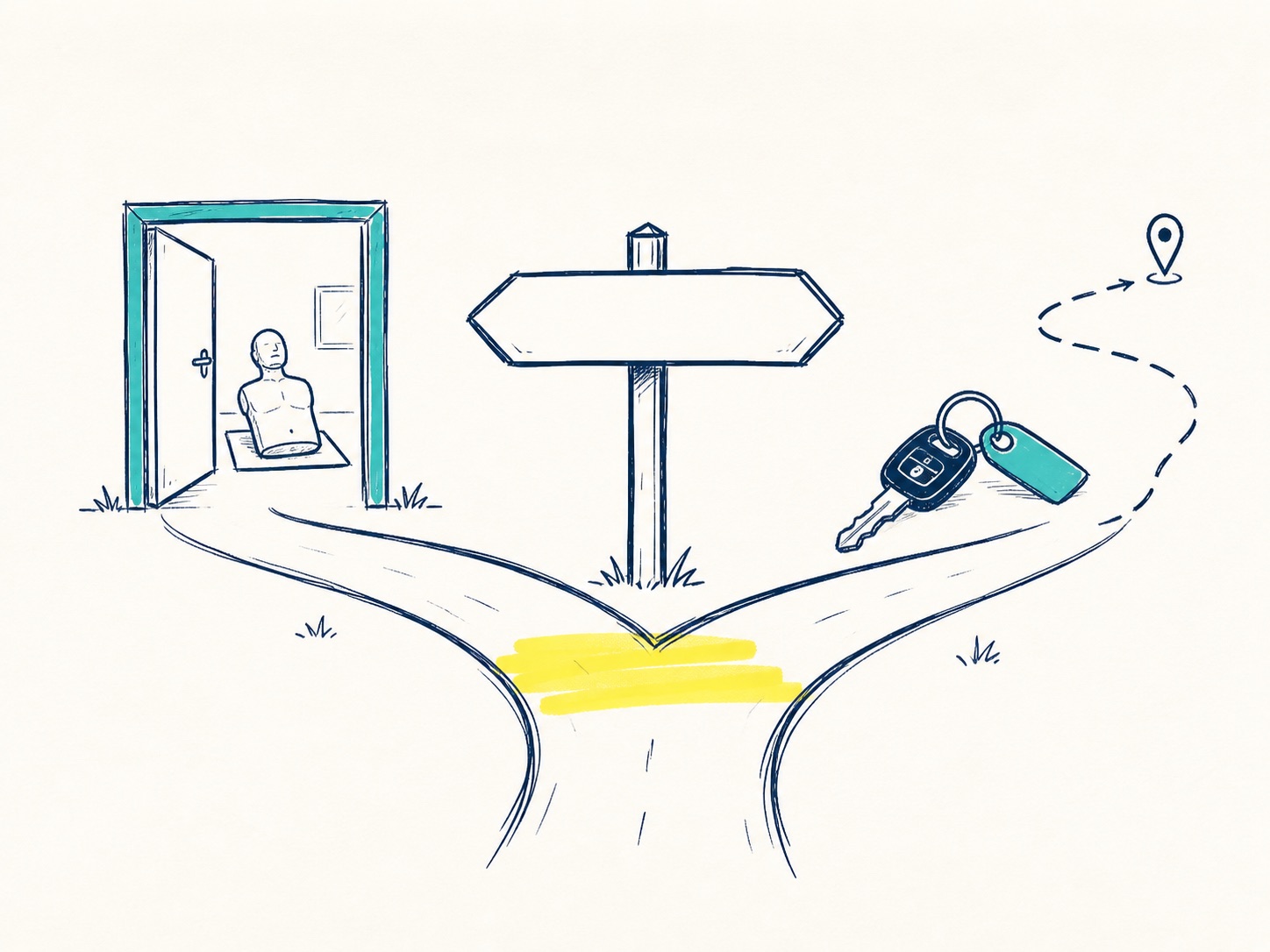
The decision framework: which should you choose?
Here's the simple version for Brisbane businesses weighing up their workplace first aid training options.
Best for most
Choose onsite if…
- You have 6+ staff needing certification
- You want to minimise downtime
- You prefer one date, everyone sorted
- Your workplace has specific hazards
- You want aligned renewal dates
For small teams
Choose offsite if…
- You have fewer than 6 staff
- It's a single new hire
- Schedules genuinely can't align
The middle path
Consider blended if…
- Team is spread across locations
- Staff prefer theory online first
- You need maximum timing flexibility
For most Brisbane businesses with a team of six or more, onsite training is the clear winner on time, cost (once you factor in the hidden expenses), and overall experience.
Planning first aid training for your team this year?
See your price in 60 secondsQueensland compliance: same certification either way
Let's clear this up, because it's the number one question people ask.
Both options deliver nationally recognised qualifications
Whether your team trains onsite or at a public venue, they receive the same nationally recognised certification. HLTAID011 (Provide First Aid) and HLTAID009 (CPR) are issued through a Registered Training Organisation (RTO) regardless of where the training happens. The delivery format doesn't change the qualification.
QLD requirements: how many first aiders do you need?
Brisbane / Queensland
First aider ratios in QLD
Under the QLD First Aid in the Workplace Code of Practice and the Work Health and Safety Act: at least 1 first aider per 50 workers in low-risk workplaces (offices, retail), and 1 per 25 in high-risk settings (construction, manufacturing, childcare). Remote workplaces often need more, depending on distance from emergency services.
WHS non-compliance is expensive
Non-compliance penalties under the Queensland WHS Act reach $50,000 for individuals and $250,000 for businesses. Serious breaches climb to $150,000 and $1.5 million respectively.
Renewal cycles
- CPR (HLTAID009): every 12 months
- Provide First Aid (HLTAID011): every 3 years
- Childcare First Aid (HLTAID012): every 3 years (CPR component annually)
Frequently asked questions
Is onsite first aid training the same qualification as a public course?
Yes. Both deliver the same nationally recognised units of competency (HLTAID011, HLTAID009) through a Registered Training Organisation. The certificate is identical regardless of where you complete it.
What's the minimum group size for onsite first aid training in Brisbane?
Most providers require a minimum of six attendees. Some have higher minimums or charge a flat-rate minimum booking fee that effectively sets the floor.
How much does onsite first aid training cost in Brisbane?
Typically from $110 per person for Provide First Aid (HLTAID011), with discounts for larger groups. Volume pricing kicks in around 18+ attendees. For an exact price, the quote calculator gives you a figure in about 60 seconds.
Can onsite training be done on weekends or after hours?
Yes. Onsite training can be scheduled to suit your team, including weekends, early mornings, or after standard business hours.
How long does an onsite first aid course take?
X-press onsite sessions run in roughly half the time of traditional full-day courses. A Provide First Aid course typically takes around four hours in X-press format, compared to seven or eight hours at most public venues.
How often should staff do first aid training?
CPR certification (HLTAID009) needs refreshing every 12 months. Full Provide First Aid (HLTAID011) is valid for three years. Most QLD businesses find it easiest to schedule one annual onsite session that covers CPR renewals and any full recertifications due that year.
The bottom line on onsite vs offsite first aid training
For most Brisbane businesses with six or more staff, onsite first aid training saves time, reduces admin, and delivers a better experience. Your team gets the same nationally recognised certification in roughly half the time, without anyone sitting in traffic or spending a full day away from work.
If you've got a small team or just need one person certified quickly, a public course does the job. No shame in that.
Either way, the important thing is that your team is trained, confident, and ready to act when it counts. Work-related injuries cost Australia $28.6 billion annually. The businesses that invest in genuine training, not just a certificate on the wall, are the ones whose people are actually prepared.
Ready when you are
Book first aid training for your Brisbane team
See your price in about 60 seconds. No forms. No phone calls. No one's going to ring you.
Get your instant quote★★★★★ 200+ five-star reviews from Brisbane workplaces