
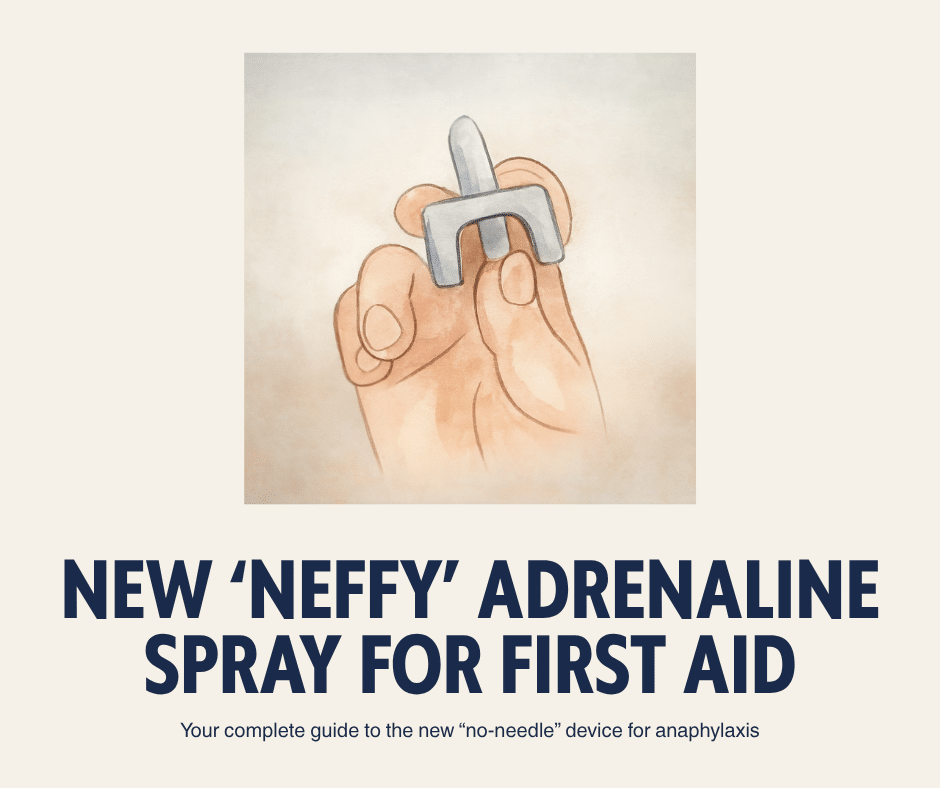
For the first time in over 30 years, Australians have a new way to treat anaphylaxis, and there’s not a needle in sight.
Neffy, a nasal adrenaline spray now available in Australia, landed in pharmacies in February 2026. It’s the first needle-free option for emergency anaphylaxis treatment ever approved in this country. And if you’re responsible for first aid in a Brisbane workplace, childcare centre, or school, it’s something your team needs to understand.
Here’s the thing: your designated first aiders could now encounter three completely different adrenaline devices in their workplace. A staff member might carry an EpiPen in their bag, a parent might send their child to daycare with a neffy nasal spray, and by mid-2026, the new Jext auto-injector will be in the mix too.
This guide breaks down everything you need to know about the neffy nasal adrenaline spray in Australia, how it works, how it compares to EpiPen, what it costs, and what it means for your team’s first aid training.
Important: Neffy is a prescription medicine. This article is general information for workplace managers and first aid officers, not medical advice. Always follow the individual’s ASCIA Action Plan and seek emergency medical help for anaphylaxis.
What Is Neffy? Australia’s First Nasal Adrenaline Spray
Neffy is a single-use nasal spray that delivers adrenaline (epinephrine) to treat anaphylaxis, the most severe form of allergic reaction. Instead of injecting adrenaline into the thigh like an EpiPen, neffy delivers it through the lining of the nose.
The Therapeutic Goods Administration (TGA) registered neffy on 8 December 2025, and it became available via private prescription from mid-February 2026. It’s manufactured by ARS Pharma and distributed in Australia by CSL Seqirus.
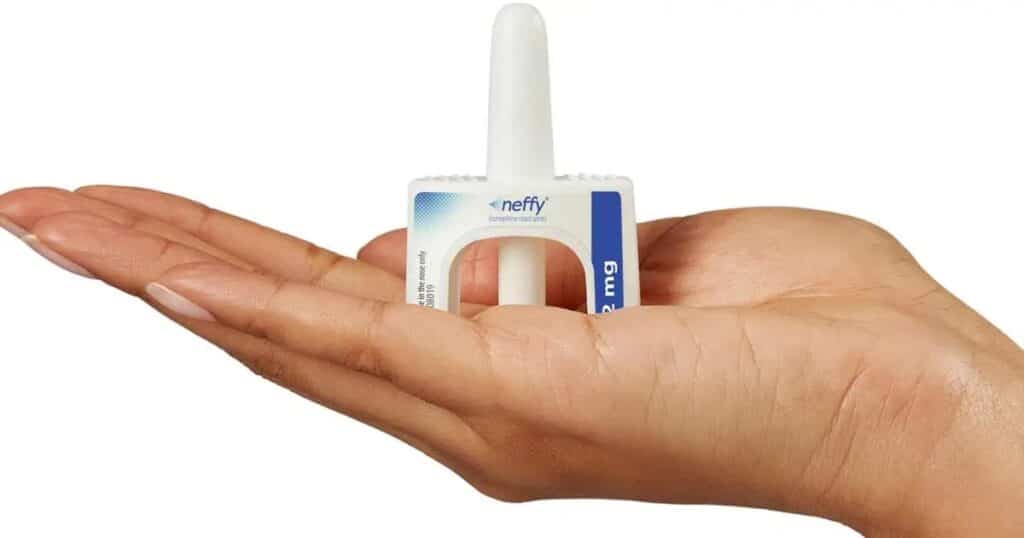
Neffy comes in two strengths:
- Neffy 2mg for adults and children weighing 30kg and over
- Neffy 1mg for children aged 4 years and older, weighing 15 to 30kg
Each device contains a single dose. That’s it, one spray, one nostril. Clinical studies show neffy’s absorption is comparable to, and in some cases faster than, traditional injection-based adrenaline products.
The fundamentals haven’t changed. Anaphylaxis is still a medical emergency. Adrenaline is still the first-line treatment. And calling 000 is still essential, every single time. Neffy simply gives us another way to deliver the adrenaline that saves lives.
If your team’s first aid training is due for renewal, it’s worth knowing that courses like the Provide First Aid (HLTAID011) course now cover neffy alongside existing auto-injector devices. Knowing what your team will encounter in the real world matters.
How to Use Neffy Nasal Spray, Step by Step
If someone in your workplace is experiencing anaphylaxis and carries a neffy device, here’s the process. It’s straightforward, but the technique matters.
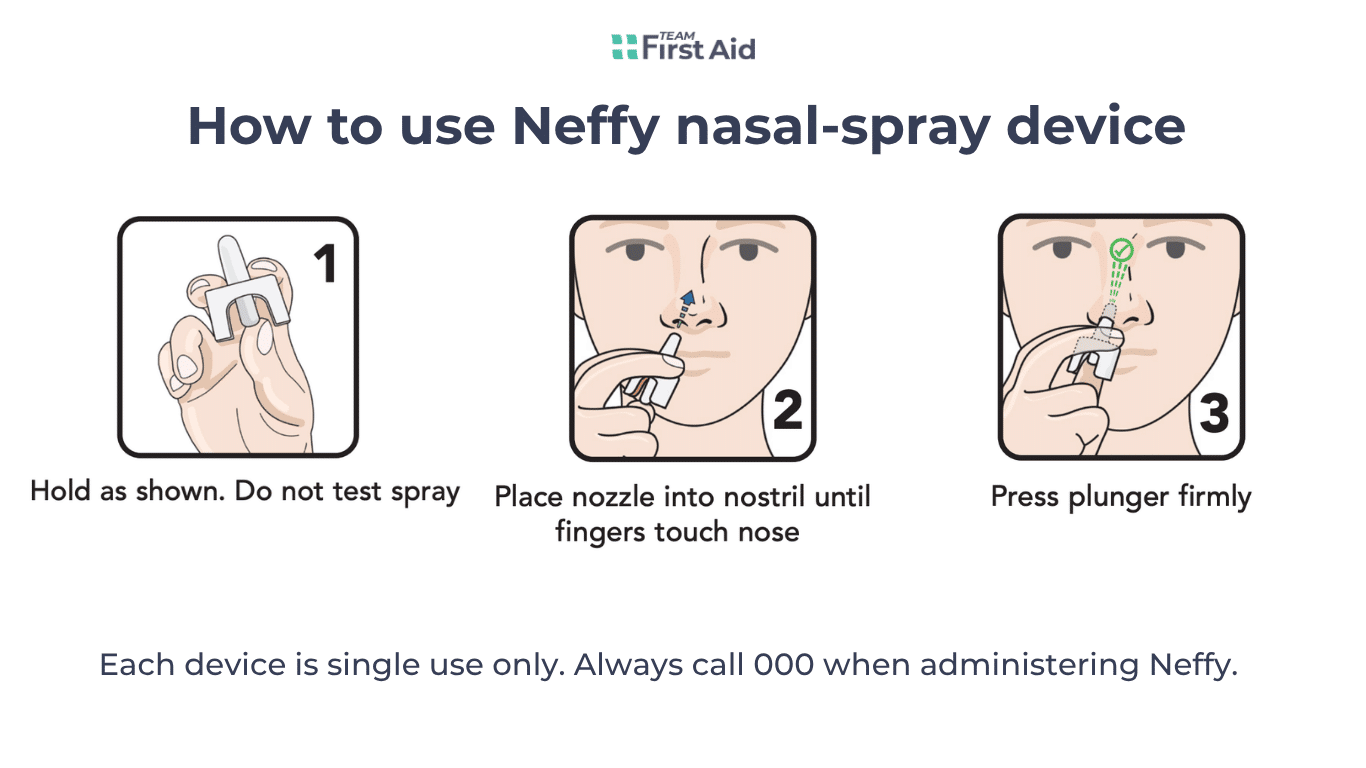
- Remove neffy from its packaging by pulling open the sealed packet.
- Hold the device correctly. Thumb on the bottom of the plunger, one finger on either side of the nozzle. Do not push or pull the plunger yet.
- Do not test spray or prime the device. Each neffy contains only one dose. A test spray means no medicine left for the emergency.
- Insert the nozzle into one nostril until your fingers touch the outside of the nose.
- Point the nozzle straight, toward the forehead. Not toward the wall between the nostrils (the septum) and not toward the outer wall of the nose.
- Press the plunger firmly upward until it clicks and stays up. That click confirms the dose has been delivered.
- The person does not need to sniff. No inhaling is required during or after the spray. The adrenaline absorbs through the nasal lining automatically.
- Position doesn’t matter. The person can be sitting, standing, or lying down. Follow the ASCIA Action Plan guidance to lay the person flat (unless they’re having breathing difficulty, in which case sit them up).
- If symptoms persist or return after 5 minutes, administer a second neffy device into the same nostril.
- Always call 000. Neffy treats the immediate emergency, but the person still needs hospital assessment.
One thing worth noting: if the person has a severely blocked or damaged nose, they may not absorb the full dose. In these cases, an injectable device like an EpiPen may be more appropriate if one is available.
Neffy vs EpiPen: What’s the Difference?
This is the question we’re hearing most from Brisbane workplace managers and first aid officers. Here’s a clear comparison.
| Feature | Neffy | EpiPen |
|---|---|---|
| Delivery method | Nasal spray (into the nostril) | Auto-injector (into the outer thigh) |
| Needle involved | No | Yes |
| Adult dose | 2mg nasal | 300mcg injection |
| Child dose | 1mg nasal (15-30kg) | EpiPen Jr 150mcg (15-30kg) |
| Minimum weight | 15kg (neffy 1mg) / 30kg (neffy 2mg) | 15kg (EpiPen Jr) / 30kg (EpiPen) |
| Availability (March 2026) | Private prescription only | Over the counter or prescription |
| PBS listed | Not yet (under consideration) | Yes |
| Approximate cost | ~$97 per device (private script) | ~$100 per device (OTC) |
| Storage | Below 25°C, do NOT refrigerate | Below 25°C, do NOT refrigerate |
| Second dose timing | After 5 minutes, same nostril | After 5 minutes |
| ASCIA Action Plan | Yes, device-specific version | Yes, device-specific version |
Both devices deliver adrenaline for the same purpose, and both are approved for use in Australia. Neffy doesn’t replace EpiPen. It’s an alternative, and the choice between them is a medical decision made by the individual and their doctor.
Worth noting: you may also encounter Anapen 500 (a 500mcg auto-injector for people over 50kg). The 150mcg and 300mcg Anapen versions were discontinued in 2024, and the 500mcg has been out of stock in Australia since mid-2025 due to a global supply shortage. However, some people may still carry unexpired Anapen devices, so your first aiders should be aware it exists. ASCIA still provides a device-specific action plan for Anapen.
For workplace first aiders, the practical difference is significant. Using an EpiPen means pushing a needle into someone’s thigh. Using neffy means putting a small spray device into their nostril and pressing a plunger. The emergency response steps around it, recognising anaphylaxis, calling 000, positioning the patient, remain exactly the same.
Why Neffy Matters for Brisbane Workplaces and Schools
Here’s a scenario that plays out in first aid training sessions more often than you’d think.
Picture a childcare educator in a Brisbane suburb. A three-year-old in her care starts showing signs of a severe allergic reaction, hives spreading rapidly, swelling around the mouth, difficulty breathing. The child has an ASCIA Action Plan and an adrenaline device in the centre’s first aid kit. The educator knows exactly what to do. She’s trained. She’s done the course.
But when she picks up the auto-injector, her hands shake. She hesitates. Not because she doesn’t know the steps, but because she’s about to push a needle into a small child’s leg, and something deep in her brain is screaming at her not to do it.
That hesitation is real. Research suggests up to 20% of people prescribed auto-injectors report reluctance to use them because of needle anxiety. In an emergency, seconds count. Hesitation costs time. And in anaphylaxis, time is adrenaline.
The nasal adrenaline spray removes that barrier entirely. There’s no needle. No exposed sharp. No injection site. Just a spray up the nose, a familiar format that most people have used before (think cold and flu sprays). For workplaces and schools where non-medical staff are the ones responding to emergencies, that familiarity could make a real difference.
This matters especially for:
- Childcare centres and schools where educators manage children with known allergies daily
- Workplaces in Brisbane’s food industry where allergen exposure risks are higher
- Aged care facilities where staff may need to administer adrenaline to residents
- Any workplace where the designated first aider is understandably nervous about using a needle-based device
This needle-free option doesn’t change the urgency of the response. It doesn’t change the need for training. But it does make the physical act of giving adrenaline less intimidating, and that’s a meaningful improvement.
Wondering whether your team’s first aid training covers the latest devices and guidelines? See your price in 60 seconds with our X-press Quote Calculator, no forms, no phone calls.
New Anaphylaxis Devices in Australia 2026: What’s Changed
The introduction of neffy (alongside the Jext auto-injector, also TGA-registered in late 2025) has prompted several updates to Australia’s anaphylaxis management guidelines.
The Australasian Society of Clinical Immunology and Allergy (ASCIA) has released updated 2026 Action Plans for Anaphylaxis. Here’s what’s changed:
Device-Specific Action Plans
ASCIA now provides five versions of the anaphylaxis action plan: one general version and four device-specific versions for EpiPen, Anapen (for those still holding stock), Jext, and neffy. Each version includes administration instructions tailored to that specific device.
For workplaces managing staff or students with allergies, this means the action plan pinned to the wall might look different depending on which device the individual has been prescribed.
Multiple Devices in Circulation
By mid-2026, Australian workplaces could realistically encounter four different adrenaline device types: EpiPen (auto-injector), neffy (nasal spray), Jext (auto-injector with different mechanics to EpiPen), and potentially Anapen 500 if someone still carries unexpired stock. For Queensland workplaces, this means your first aid arrangements under the QLD Work Health and Safety Act need to account for this growing range of devices.
For a childcare centre in Brisbane’s north, this might mean one child carries an EpiPen and another carries neffy. Your first aiders need to be confident with all of them.
Other Key Updates
- CPR guidance refined: “Unresponsive OR not breathing normally” now triggers CPR (previously “and,” which could cause confusion). This applies to all first aid responses, not just anaphylaxis. If your team’s CPR certification is due for renewal, the updated wording is covered in the refresher.
- Positioning reinforced: “Lay person flat, do NOT allow them to stand or walk” is emphasised more strongly in the 2026 plans.
- Prescriber language updated: “Prescribers” replaces “doctor or nurse practitioner,” reflecting expanded prescribing authority for registered nurses.
- Recognition update: “Anaphylaxis can occur without skin symptoms” is now stated explicitly on the plans.
What Neffy Means for Your Workplace Anaphylaxis First Aid Training
If you’re the person responsible for organising first aid training at your Brisbane or Queensland workplace, here’s the practical takeaway.
Your First Aiders Need to Recognise Multiple Devices
It’s no longer enough to train staff on a single adrenaline device. A first aider might be handed a device they’ve never seen before and need to use it confidently under pressure. Training that covers EpiPen, neffy, Jext, and Anapen gives your team the confidence to respond regardless of what device they encounter.
Updated Training Reflects 2026 Guidelines
If your team’s last first aid course was before 2026, they were trained before neffy existed in Australia. The ASCIA Action Plans have been updated, the device landscape has changed, and the CPR guidance has been refined. A refresher course brings everyone up to speed.
At Team First Aid, our Provide First Aid and Childcare First Aid courses cover all current adrenaline devices, including neffy. Our trainers walk your team through the differences between devices, practise the administration technique, and make sure everyone leaves confident rather than confused.
Workplace First Aid Kit Considerations
Should you add a neffy to your workplace first aid kit? Here’s the current situation:
- EpiPen can be purchased over the counter at pharmacies (~$100) for general-use workplace first aid kits, based on your risk assessment.
- Neffy is currently prescription-only (Schedule 4). You can’t buy it over the counter for a general first aid kit. If neffy is included in your workplace kit, it would need to be prescribed.
- Whether your workplace needs an adrenaline device at all depends on your workplace risk assessment. Workplaces with higher allergen exposure (food processing, childcare, healthcare) are more likely to benefit from having one.
Even if your first aid kit doesn’t contain a neffy device, your first aiders should still know how to use one, because a staff member, visitor, or child in your care might carry one themselves.
Neffy Cost and Availability in Australia (2026)
Here’s where things stand as of March 2026.
Availability: Neffy is available in Australia via private prescription only. Your doctor or prescriber writes a script, and you fill it at a pharmacy. It’s not yet available over the counter.
Cost: The recommended retail price is approximately $194 for a box containing two neffy devices. Some pharmacies may sell individual devices for around $97 each, though pricing can vary between pharmacies.
PBS status: CSL Seqirus has submitted an application for neffy to be listed on the Pharmaceutical Benefits Scheme (PBS). The Pharmaceutical Benefits Advisory Committee (PBAC) was due to consider this in March 2026. If approved for the PBS, the cost to patients would drop significantly, particularly for concession card holders.
Storage: Neffy must be stored below 25°C at room temperature. Unlike what you might assume, do not store it in the fridge. There’s a risk it could accidentally freeze, which may affect the medication.
For comparison, an EpiPen can be purchased over the counter for approximately $100 per device, or at a reduced cost with a PBS prescription. Once neffy receives PBS listing (if approved), the cost difference between the two devices may narrow considerably. We’ll update this section when the PBS decision is announced.
FAQs About Neffy and Anaphylaxis First Aid
What is neffy?
Neffy is a needle-free nasal adrenaline spray approved in Australia for the emergency treatment of anaphylaxis in adults and children weighing 15kg or more and aged four years and over. It was TGA-approved in December 2025 and became available by prescription from February 2026. It’s distributed in Australia by CSL Seqirus.
Does neffy replace EpiPen?
No. Neffy is an alternative to auto-injectors like EpiPen, not a replacement. The choice between neffy and an auto-injector is a medical decision made by the individual and their prescriber. Both are approved treatments for anaphylaxis.
Can anyone buy neffy in Australia?
Not yet. As of March 2026, neffy is a Schedule 4 prescription medicine. You need a prescription from a doctor or authorised prescriber. It’s not available over the counter at pharmacies like EpiPen currently is.
Should my workplace have neffy in the first aid kit?
That depends on your workplace risk assessment. Because neffy is currently prescription-only, it can’t simply be purchased for a general workplace first aid kit the way an EpiPen can. However, your first aiders should still know how to use neffy, as staff or visitors may carry one.
Will first aid training courses cover neffy?
Yes. Updated first aid courses, including the Provide First Aid (HLTAID011) and Childcare First Aid (HLTAID012) courses, now cover all TGA-approved adrenaline devices including neffy. At Team First Aid, we train your team on neffy alongside EpiPen and Jext so they’re confident with whatever device they encounter.
Is neffy on the PBS?
Not yet as of March 2026. An application has been submitted and is under consideration. If listed, the subsidised cost would make neffy significantly more affordable for individuals.
The Bottom Line for Brisbane Workplaces
Neffy is genuinely good news. A needle-free option for anaphylaxis treatment removes one of the biggest barriers to fast adrenaline administration, the fear of using a needle on someone (or yourself). For childcare centres, schools, and workplaces across Brisbane, it means one more tool in the kit for keeping people safe.
But it also means the first aid landscape just got a bit more complicated. Three different adrenaline devices. Updated ASCIA guidelines. New action plans. Your team’s first aid training needs to reflect the world they’ll actually be responding in, not the one from two years ago.
If your team’s certification is due for renewal, or if you just want to make sure your first aiders are across the latest devices and guidelines, we can help. The neffy nasal adrenaline spray is now part of what your team learns in an Australian first aid course, and our X-press onsite training covers current adrenaline devices through learner-paced preparation and focused trainer-led practical training at your Brisbane workplace.
Get an instant quote for your team, it takes about 60 seconds, and no one’s going to ring you.
Go Team!
This article provides general information for workplace managers and first aid officers. It is not medical advice. For individual medical decisions about adrenaline devices, consult your doctor or prescriber. For clinical guidance on anaphylaxis management, refer to ASCIA and Allergy & Anaphylaxis Australia. In a medical emergency, always call 000.
Information in this article is current as of March 2026. Neffy availability, PBS status, and pricing may change. We’ll update this article as new information becomes available.